
October 17, 2026
How to build an opening repertoire that survives real games
Andrew
A repertoire fails one way: your opponent plays a move that isn't in your notes on move four, and you're on your own five minutes into the game. More memorization doesn't fix that. Building the repertoire around what you understand, and what you actually face, does.
Start embarrassingly narrow. One opening as White, one defence to 1.e4, one to 1.d4. Depth survives contact and breadth doesn't. You can widen later. You can't fake understanding with a clock running.
Pick the middlegame you want to play. Every sound opening is "fine", and the 0.2 the engine prefers is irrelevant next to the question that matters: which middlegame do you want to play two hundred times? If you grind endgames well, play the Berlin and stop apologizing for it. If you need the initiative to think, the engine's approval of a quiet line is worth nothing to you.
Learn the plan, then the moves. A move list abandons you at move ten. Structure, piece placement and the intended break cover every move your opponent plays that theory didn't predict, which at club level is most of them. Test yourself: if you can't say what your side does in the resulting middlegame, you don't know the line yet, whatever your recall says.
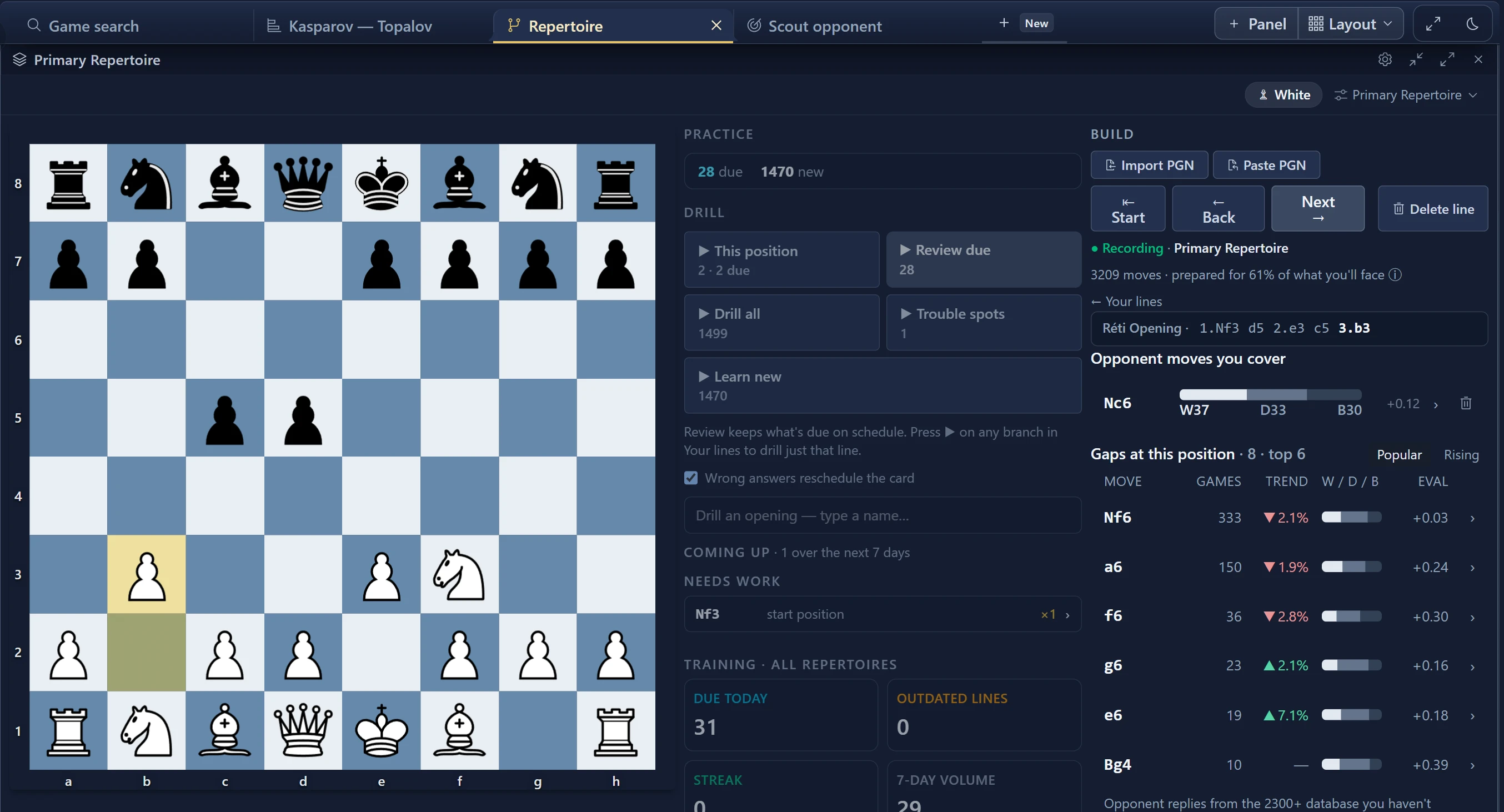
Grow it from your own games. This is the step that separates a repertoire from a course. After every game, find where you left preparation and decide, with the database open, what you'll play next time. Check the line against real tournament games. If 48 games reach your position and you had no answer prepared, that's the repertoire telling you where it's thin. Built this way, the repertoire ends up shaped exactly like the chess you actually face.
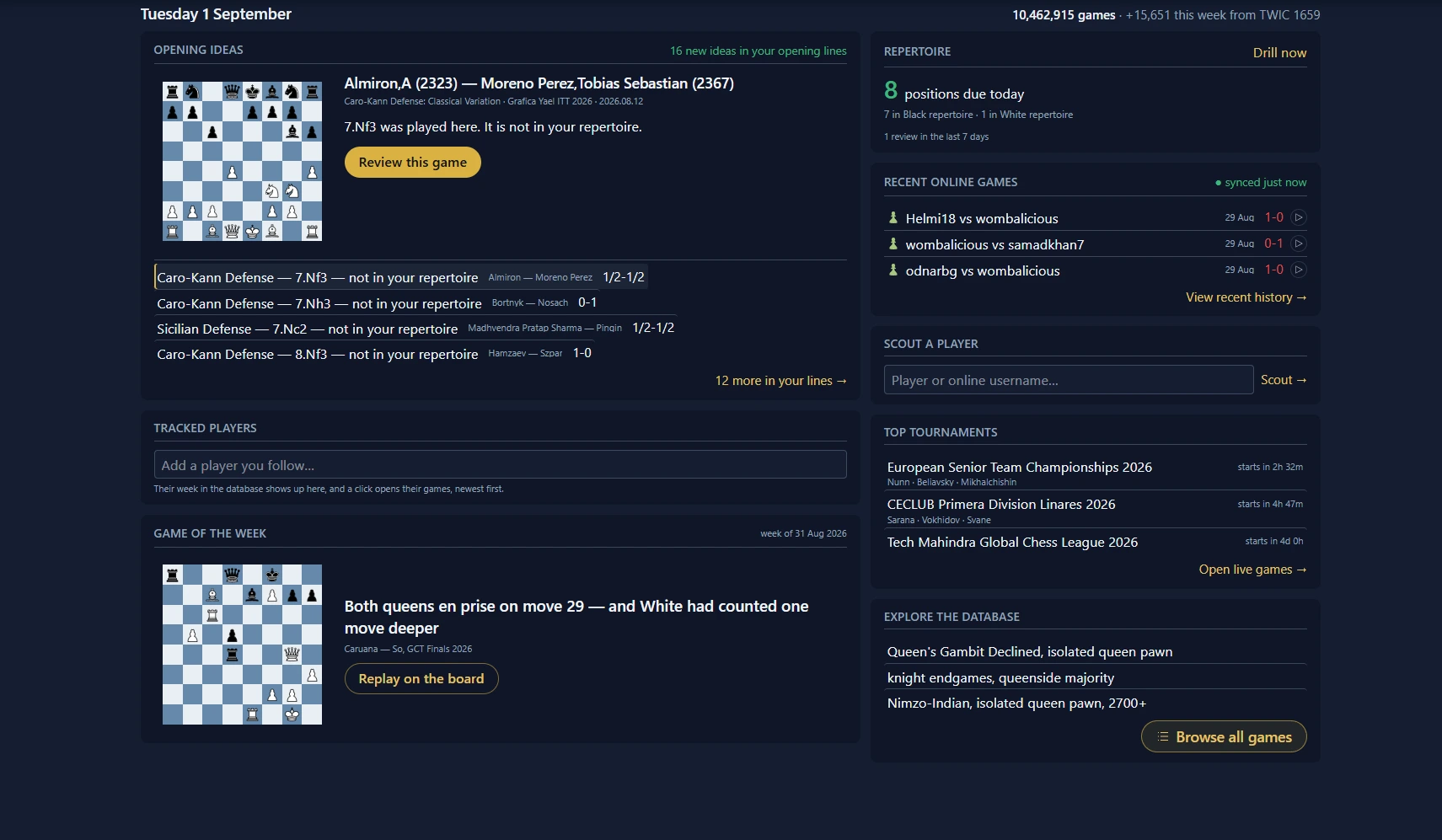
Drill it or it's a document. Spaced repetition on your own lines, on a board, fifteen minutes a day. The why and how is its own post.
Maintain it. Lines get re-evaluated, your memory fades, new games expose gaps. A repertoire is something you tend.
In FlexiChess
Build the tree by hand, import it from PGN (a ChessBase export works, it's just a PGN), or have it built from a player's games, including your own. Lines you paste in merge with what's there, nothing gets overwritten. Check any position in it against 10.4 million tournament games, and add a line from any game you're looking at with a right-click on the move. Drill it with the built-in FSRS trainer. Edits save as you make them once you're signed in, and the whole thing exports back to PGN. Free with a free account, with room for 50 saved repertoires (200 on Pro).
Try it: Start the tree in FlexiChess, free. Open FlexiChess →
Related: Why you forget your opening prep, and how spaced repetition fixes it · How to search any chess position across millions of tournament games
← All posts